
What is the acupuncture? What are the techniques of acupuncture?
Acupuncture is undoubtedly the branch of Traditional Chinese Medicine best known to Western audiences, because it was the first Chinese therapeutic technique to be introduced in world, first in the seventeenth century through the Dutch and Portuguese who entertained direct trade relations with the empire of China, and later, in the twentieth century by doctors of Indochinese origin. Today acupuncture is practiced throughout the world and is chosen by millions of people as therapy.
A bit of history
The Chinese term for acupuncture is “Zhen ago.” The stimulation of points of the body surface using sharp instruments for therapeutic purposes is documented in China since the Neolithic age. They were in fact discovered sharp stones known as “bian zhen” which according to some historical sources were used just to treat diseases with this technique. With the advent of metallurgy, they built the first metal needles and the technique became more refined and began to be systematized according to the principles of Traditional Chinese Medicine.
How does it work?
According to the theory of meridians, or energy channels, our body is crossed by paths that lead and regulate the energy produced and stored by the organs and viscera, ensuring all vital functions. The meridians are basically classified into primary, secondary and extraordinary or curious.
The main meridians are twelve and they are in relation to the six organs (lung, kidney, liver, heart, pericardium, spleen) and the six viscera (large intestine, urinary bladder, gall bladder, small intestine, triple heater, stomach). These meridians are divided into yang, those that carry energy from the end of the hands to the head and hence the foot, yin and those who carry the energy from the foot to the trunk, and from here to the hands. The secondary meridians are more superficial ramifications of the main meridians that serve to connect together the past and to distribute the energy and nourishment to all tissues. The concept is precisely analogous to that of a well-organized network of channels.
The extraordinary meridians are eight (first number in numerology Taoist) and have a function of “reservoir” energy, so as to absorb the “full” and refuel in the case of “dry canals”.
On each meridian point, they have been identified in the centuries that flow to the skin surface, where you can feel the energy and act on it. It is precisely the so-called “acupoints”.
Act on the acupoints with any form of stimulation is equivalent to change in some way the characteristics of energy flowing at that given point and at that meridian.
The insertion of a needle bimetallic is the standard stimulation technique used today by acupuncturists. Numerous scientific studies, the most recent of which have used cutting-edge technologies such as computer tomography (PET emission) have unequivocally shown that the claims for thousands of years by the Chinese doctors are a reality. In fact, the stimulation by means of a needle in an advertisement acupoint suitable to treat a pain syndrome has shown itself capable of producing the objective changes in brain areas which control the processes of pain, while the needle insertion at another point random has not produced the same effect.
Each point, according to its location, the meridian which it belongs and to other anatomical characteristics or related to clinical practice, has very specific therapeutic properties. The combination of different points according to the principles of Chinese medicine allows optimizing efficiency and precision of intervention.
How to use the needles?
In an acupuncture session, the doctor, who has already put a diagnosis during the visit according to the principles of Traditional Chinese Medicine, identifies the patient’s body surface points which, in combination, make up the chosen therapeutic formula.
Currently, sterile disposable needles are used steel and copper, which ensure maximum hygienic safety.
Although in every case to be inserted with a rapid maneuver, and for the most part painless needle in the superficial layers of the skin, to obtain the exact stimulation that the medical research in order to achieve a given result, the needle goes more or less depth and handled accordingly (there are many types of needle manipulation). At this stage, the patient will feel the characteristics sensations (tingling, heaviness, electric shock sensations, etc.) that indicate the dynamics of energy in the meridian made by needle stimulation. At this point, the needles are left inserted in point for a few minutes. In certain cases the needle, once the energy sensation obtained is to be immediately removed, in other is raised after 15-20 minutes or more.
Some acupuncture effects are immediately apparent: it is the relaxing effect and the analgesic action occurring within a few minutes from the insertion needle. Other effects, involving complex energy systems, are felt after some time.
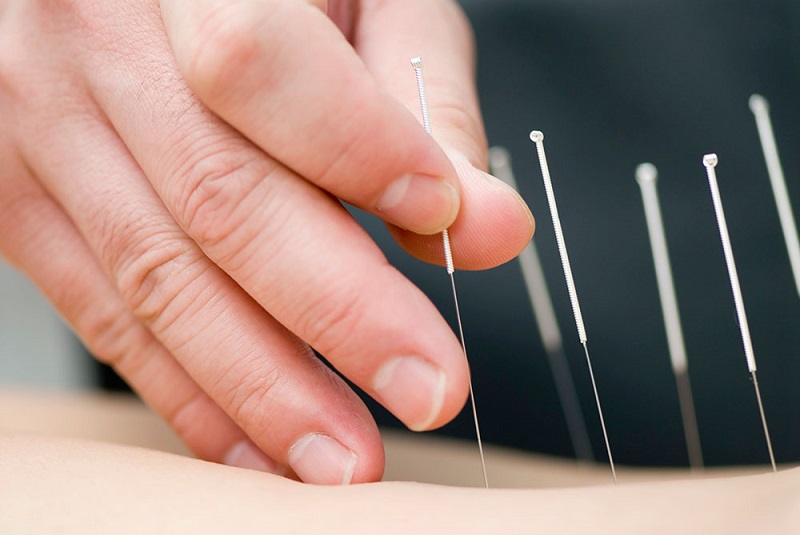 Tools and techniques acupuncture
Although the term refers directly all infusion Acupuncture needles into the skin, this ancient medical art includes in its therapeutic arsenal numerous other instruments that, used wisely make the intervention of the acupuncturist extremely flexible and effective.
Moxibustion
Old as the massage is the application of heat to cure diseases, particularly for pain relief. The doctors of ancient China had discovered that the stimulation of acupuncture points with the heat could get interesting effects, taking advantage of the specific properties of individual points. The main instrument to bring the heat on the points consisted of dried and pulverized medicinal herbs, which were tablets, placed on the skin and burned up to transmit the heat sensation in the meridian. In “Treatise on febrile diseases due to the cold,” the doctor Zhang Zhong Jing of the II century AD recommended burning the sticks of cinnamon to warm the appropriate steps to expel pathogenic cold from the body by stimulating perspiration. In time, Chinese medicine has selected as the main herb for this purpose the Artemisia, with whose dried and crushed leaves are preparing a fluff by compressed be used in cones or rolled up in sticks. The Japanese have named this moxa technique and this term has been more successful in the Chinese term jiu ago, becoming synonymous with Artemisia. For this reason, the technique is now known as moxibustion.
The heat can be carried with the moxa directly supporting the cones on the skin or in an indirect way by placing between the cone and the skin a compressed medicated with herbs or a slice of ginger or garlic or using the moxa roll on and approached the point to be treated. The moxibustion can also be associated with acupuncture to heat more in depth using the needle as the heat vehicle.
This technical course is elective in all diseases due to cold, but it is also an important toning system in syndromes characterized by weakness and chilliness, in prolapses, in dyspepsia.
Application examples
A remedy for cold dysentery: put the large rooms in the navel (point Shenque), turn on a roll of moxa and heat the point at approximately 2 cm distance for 5-10 minutes. For a sore throat from the cold (not the one with fever and plates!), you can warm the point hegu located at the junction between the thumb and forefinger of the hand towards the wrist. To treat hemorrhoids and prolapsed and even if you are tired, you can warm the point bai hui at the top of the head, at the junction of the line passing through the bridge of the nose and the one that connects the lobes and the apexes of the two ears. In the case of the breech position of the fetus, a technique of turning extensively studied and the efficacy of which is documented scientifically it consists in heating the point with moxa Zhiyin, which is located in correspondence of the angle outside the nail of the fifth finger of the feet.
Cupping
A technique also known in the West, even if applied with different criteria from those of Chinese medicine is cupping. It is to apply the suction cups on the points to be treated and exercise more or less intense up to draw in the subcutaneous fluid suction action and blood. The Chinese today often use the cups in plastic or glass vacuum tire, but it is still widely used the technique of making a vacuum quickly passed flame inside the cup, which can be of bamboo wood or glass.
According to the Chinese medicine, this technique is shown in all forms characterized by the presence of catarrh or moisture. Therefore, it applies, particularly in respiratory and rheumatic diseases. However, there are also particular applications of this technique, useful to treat anxiety and insomnia or to treat dyspeptic disorders of children.
In practice, the doctor applies rapidly cups on the points to be treated by exerting more or less intense according to an aspiration that needs to get a strong drainage or just an activation of energy circulation. This sucking action super focalizes body energy and with it brings to ‘external pathogenic factors, and in particular moisture or the stagnant blood. The technique can also be associated to the phlebotomy (pricks the point until it bled, then applies the cup) or acupuncture (covers the needle point with a fixture on the cup).
A special technique is the “cup swiping”. A massage oil is rubbed on the patient’s back, apply the cup with fairly vigorous aspiration and it is pushed along the sides of the spine in one direction first and then in the other, maintaining the action of the suction cup, until getting a reddening of the skin. The effect is very relaxing and invigorating at the same time.
To have an idea of the effectiveness of this technique, consider that the application of a strong cupping the back on two specific points (point fengmen) can stop an asthma attack within seconds.
Acupuncture, indications, and evidence
The Acupuncture understood in the context of Traditional Chinese Medicine can be rightly considered as a therapeutic technique in itself almost complete, able to be of benefit in many pathologies. Ancient and modern Chinese classical texts contemplate many effective applications of traditional acupuncture techniques and clinical experience of the many lovers of this therapeutic technique in the world is a proof of the continued goodness of ancient Chinese medical insights.
In the West for many years, Acupuncture is put under examination by the medical establishment and have published numerous studies on its various applications. In scientific databases, even the on Acupuncture works outnumber those on homeopathy. Although still awaiting reliable studies on all applications, it has now been established the virtues of acupuncture in some specific fields.
The limit of the studies that seek to scientifically validate this technique is the difficulty of studying their methods of scientific language and Western medical phenomena that Chinese medicine explains with a very different language. For example, when the Chinese medicine states that in a given way by manipulating the needle after the insertion, tonifichiamo the acupoint refers to a very specific effect from the point of view of the Chinese medical language, based energetic, but the same concept cannot be translated directly and uniquely in biophysical terms.
Despite these difficulties, it has been documented with the most modern imaging techniques such as positron emission tomography, that acupuncture performed on energetically active points (the ones used in Chinese medicine), using the techniques of piling own ‘traditional acupuncture, produces changes reflected in specific brain areas, which could explain its therapeutic action. The simple needle inflexion or the driving of areas of the skin different from those energetically active does not produce the same effect.
The clinical applications of acupuncture recognized effective by the scientific community generally in the effects of stimulation of a specific acupoint, although in Chinese tradition are used most combined points according to specific criteria of synergy. In particular, it is proven the effectiveness of some pathology.
Nausea and vomiting associated with pregnancy, the postoperative course or cancer chemotherapy, respond very well Acupuncture on a point of the arm, called in Chinese neiguan (PC6 according to the WHO classification), as has also been recognized by the FDA (Food and drug Administration) American, the body responsible for evaluating the efficacy and safety of drugs and therapeutic techniques.
Spot stimulation jiaosun (TE20) placed on the scalp at the ear apex, has proved capable of regulating the hormone secretion in the functional.
A technique much used and much studied is the stimulation needle or moxibustion point Zhiyin (BL67, the outer corner of the fifth toenail) the pregnant, to get smoothly and virtually free of side effects the reversal of a fetus that is in the breech position during the last month of gestation.
Several points are used individually or in combination to obtain an analgesic effect, it can also be used for anesthesia in the course of surgery or to alleviate the pain of labor.
Auricular acupuncture techniques such as acupuncture have long been used successfully by well-tested protocols in the cessation of cigarette smoking and addiction.
In addition to these indications validated, there are many pieces of evidence at the time investigated through study projects in several countries, the effectiveness of acupuncture in diseases such as low back pain, sciatica, headache, trigeminal neuralgia, high blood pressure, the climacteric disorders, disorders of the menstrual rhythm sleep disorders. The data derived from these studies conducted and abroad are very encouraging and confirm that it is not only an analgesic technique ( a field in which is often confined) but a therapeutic approach capable of regulating the physiology of human organism.
Given the virtual absence of side effects, acupuncture stands today as a promising and safe therapeutic tool, it is still paramount always turn to proven medical experience and who have followed a specific training process. The educational standard now recognized as basic throughout the communities provides theoretical and practical courses of at least four years.


About The Author
